

.jpeg)
.jpeg)
.jpeg)
.jpeg)
.jpeg)
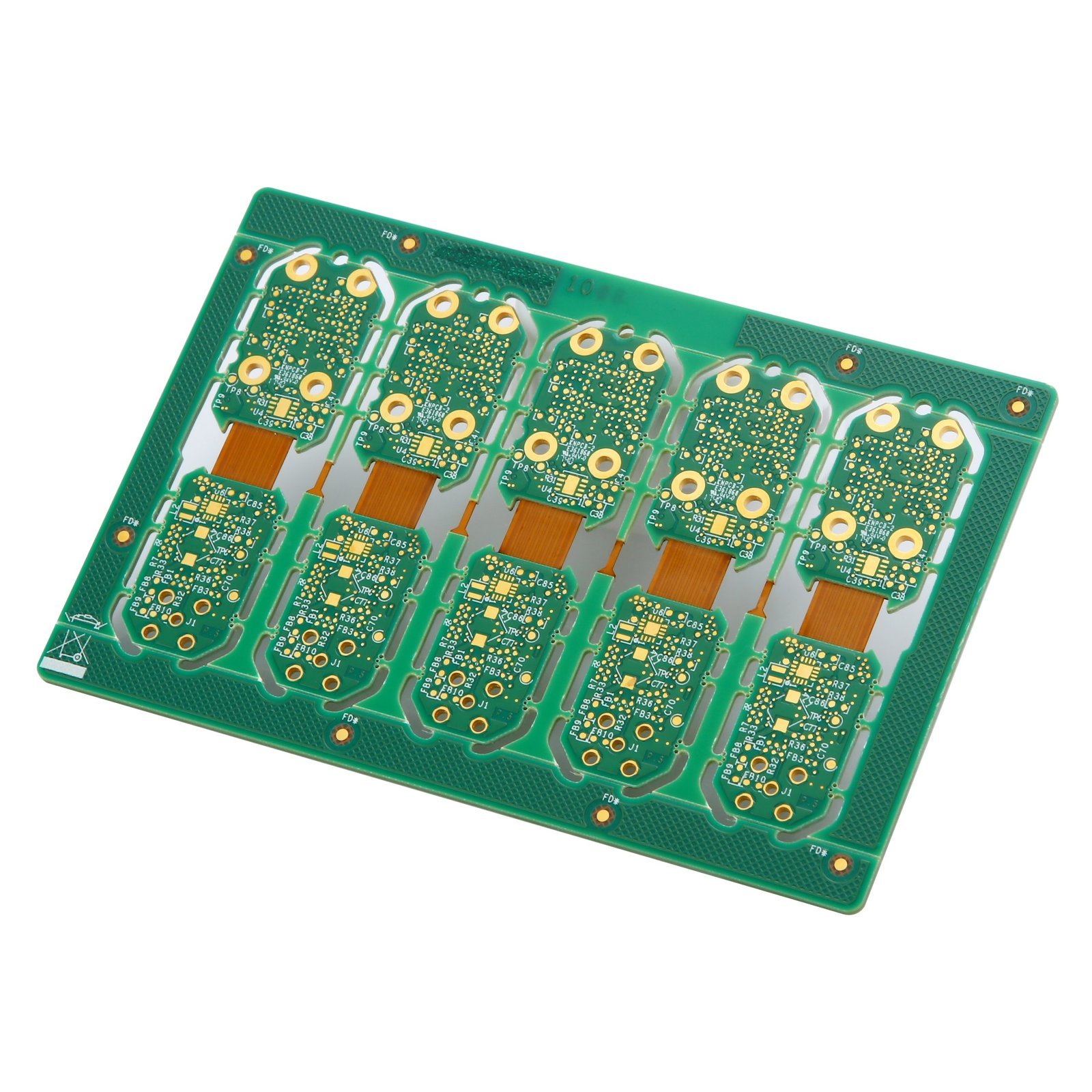
🔶 Key Advantages of Rigid-Flex PCBs
Rigid-flex PCBs bring distinct design and performance advantages compared to traditional designs:
-
📦 Space & weight savings through 3D routing and the elimination of bulky connectors
-
🔗 Higher reliability with fewer interconnects and solder joints
-
🔧 Simplified assembly and testing, improving manufacturing efficiency
-
🔌 Modular integration, allowing more efficient mechanical design
-
📐 Supports complex mechanical layouts, folding structures, and dynamic bending
-
⚠️ Note: The complexity of manufacturing leads to higher unit cost, longer lead time, and lower yield compared to standard PCBs.
🔶 Applications of Rigid-Flex PCBs
● Consumer Electronics
Rigid-flex PCBs are widely used in high-end electronics requiring compact form factors and flexible interconnects:
-
Foldable smartphones and tablets
-
Wearables and smart glasses
-
Laptop hinges and camera modules
-
RF communication modules
● Automotive Electronics
Ideal for integrating multiple functions in limited spaces, including:
-
Steering wheel control interfaces
-
Touchscreens and dashboard displays
-
Seat control panels
-
In-vehicle entertainment systems
-
Navigation and radar modules
● Industrial and Medical Equipment
Used to ensure reliable signal integrity, low impedance loss, and mechanical resilience across multiple connected boards in:
-
Surgical and diagnostic equipment
-
Industrial control modules
-
Robotic arms and sensor nodes
-
Aerospace-grade monitoring systems
🔶 Technical Specifications
| Number of Layers | 4 – 26 layers |
| Technology Highlights | Mixed materials: RF, high-speed, standard FR4, polyimide Adhesiveless or adhesive-based flex, with coverlay or flexible solder mask |
| Bending Performance | From basic 90° bends to full 360° dynamic flex for continuous motion applications |
| Bend Features | Bend radius depends on material thickness – thinner flex allows tighter bends |
| Materials | RA Copper, HTE Copper, FR4, Polyimide, Adhesive |
| Finished Copper Weights | 0.5 oz, 1 oz, 2 oz, 3 oz |
| Minimum Track / Gap | 0.075 mm / 0.075 mm |
| PCB Thickness | 0.40 mm – 3.0 mm |
| Flex Section Thickness | 0.05 mm – 0.80 mm |
| Maximum Dimensions | 457 mm × 610 mm |
| Surface Finishes | ENIG, OSP, Immersion Tin, Immersion Silver |
| Minimum Mechanical Drill | 0.20 mm |